
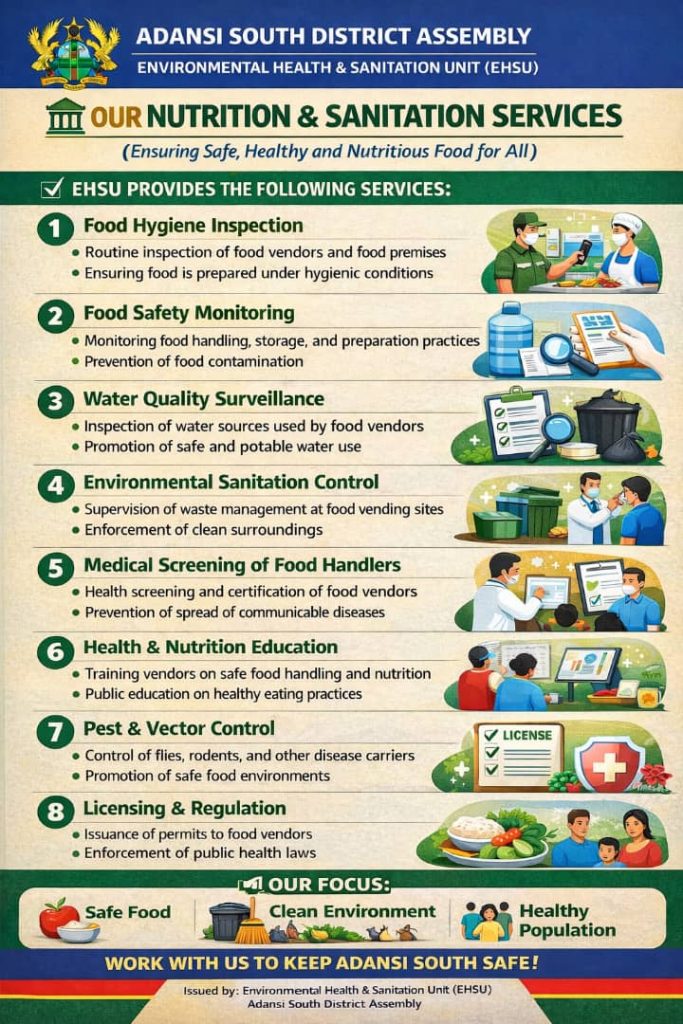
NUTRITION & SANITATION SERVICES – ADANSI SOUTH DISTRICT
Environmental Health & Sanitation Unit (EHSU)
Our Mission
To ensure safe, healthy, and nutritious food for all residents and visitors of Adansi South District through effective hygiene inspection, food safety monitoring, and public education.
Welcome Message
The Environmental Health & Sanitation Unit (EHSU) of the Adansi South District Assembly is committed to protecting public health by ensuring that all food sold and consumed within the district is safe, hygienic, and nutritious. We work closely with food vendors, market operators, schools, and households to promote best practices in food handling, environmental sanitation, and personal hygiene.
Our Nutrition & Sanitation Services
EHSU provides the following essential services to safeguard the health of our communities:
Food Hygiene Inspection
|
Activity |
Description |
|
Routine inspection of food vendors and food premises |
Regular, unannounced visits to all food selling points across the district |
|
Ensuring food is prepared under hygienic conditions |
Monitoring cooking environments, utensils, and personal hygiene of food handlers |
Food Safety Monitoring
|
Activity |
Description |
|
Monitoring food handling, storage, and preparation practices |
Checking temperatures, storage containers, and separation of raw and cooked foods |
|
Prevention of food contamination |
Identifying and eliminating risks of chemical, biological, and physical contamination |
Water Quality Surveillance
|
Activity |
Description |
|
Inspection of water sources used by food vendors |
Testing water from boreholes, wells, pipes, and stored containers |
|
Promotion of safe and potable water use |
Educating vendors and households on water treatment methods (boiling, chlorination, filtration) |
Environmental Sanitation Control
|
Activity |
Description |
|
Supervision of waste management at food vending sites |
Ensuring proper disposal of solid and liquid waste |
|
Enforcement of clean surroundings |
Requiring vendors to maintain litter-free, pest-free environments |
Medical Screening of Food Handlers
|
Activity |
Description |
|
Health screening and certification of food vendors |
Mandatory medical checks for all food handlers (including typhoid, and skin infections) |
|
Prevention of spread of communicable diseases |
Ensuring infected individuals do not handle food until cleared by a medical professional |
- Health & Nutrition Education
|
Activity |
Description |
|
Training vendors on safe food handling and nutrition |
Workshops and one-on-one coaching on hygiene, balanced meals, and portion control |
|
Public education on healthy eating practices |
Community durbars, school talks, and radio discussions on nutrition |
Pest & Vector Control
|
Activity |
Description |
|
Control of flies, rodents, and other disease carriers |
Spraying, trapping, and sanitation measures to reduce pests |
|
Promotion of safe food environments |
Advising vendors on proper waste storage and covering of food |
Licensing & Regulation
|
Activity |
Description |
|
Issuance of permits to food vendors |
All food vendors must obtain a valid license before operating |
|
Enforcement of public health laws |
Sanctions for non-compliance, including closure of unsafe food establishments |
Our Focus
|
Focus Area |
Goal |
|
Safe Food |
Every meal sold or prepared in Adansi South is free from contamination |
|
Clean Environment |
Food vending sites are clean, organized, and pest-free |
|
Healthy Population |
Reduced cases of foodborne illness and improved nutrition for all residents |
Why Nutrition Matters in Adansi South
|
Issue |
Our Response |
|
Foodborne diseases (diarrhea, typhoid, cholera) |
Regular inspections and medical screening of food handlers |
|
Poor food handling practices |
Mandatory training and certification for all vendors |
|
Contaminated water sources |
Water quality surveillance and promotion of safe water use |
|
Pest infestation at vending sites |
Routine pest control and environmental sanitation enforcement |
|
Lack of nutrition awareness |
Public education campaigns on healthy eating |
How to Access Our Services
|
Service |
How to Access |
|
Food vendor license |
Visit EHSU office at the District Assembly, New Edubiase |
|
Food handler medical screening |
Visit any designated health facility (list available at EHSU office) |
|
Report an unsafe food vendor |
Call our helpline or report at any Area Council office |
|
Request nutrition education for your community |
Contact EHSU to schedule a community durbar or school talk |
|
Pest control assistance |
Report infestation to EHSU for assessment and action |
HELPLINE
Report unsafe food, pest infestation, or sanitation concerns
📞 024 727 0730
Call or WhatsApp | Monday – Friday, 8:00 AM – 5:00 PM
What You Can Report
|
Issue |
Action |
|
Dirty food vending site |
Call or WhatsApp |
|
Food vendor without a license |
Call |
|
Suspected food poisoning |
Call immediately |
|
Rodent or fly infestation at a food stall |
Call or WhatsApp |
|
Vendor using unsafe water |
Call |
|
No handwashing facilities at food stall |
Call |
|
General sanitation concern |
Call or WhatsApp |
Important Information for Food Vendors
Steps to Obtain a Food Vendor License
|
Step |
Action |
|
1 |
Visit the EHSU office at the District Assembly, New Edubiase |
|
2 |
Complete a food vendor registration form |
|
3 |
Undergo medical screening at a designated health facility |
|
4 |
Attend a food hygiene training session (scheduled monthly) |
|
5 |
Pass an on-site inspection of your food premises |
|
6 |
Pay the required license fee |
|
7 |
Receive your license (valid for one year, renewable annually) |
Food Vendor Code of Conduct
All licensed food vendors in Adansi South must adhere to the following:
|
Rule |
Requirement |
|
1 |
Wear clean apron and hairnet at all times |
|
2 |
Wash hands with soap before handling food |
|
3 |
Cover all food displayed for sale |
|
4 |
Keep vending site clean and free of rubbish |
|
5 |
Store raw and cooked food separately |
|
6 |
Use only potable water for cooking and drinking |
|
7 |
Dispose of waste in designated bins |
|
8 |
Renew license annually |
|
9 |
Report any illness to EHSU immediately |
|
10 |
Cooperate with EHSU inspectors during visits |
Nutrition Education Topics We Cover
|
Topic |
Target Audience |
|
Balanced diet for families |
General public |
|
Safe weaning foods for infants |
Mothers and caregivers |
|
Nutrition for school-age children |
Students and teachers |
|
Healthy eating on a budget |
Low-income households |
|
Food storage and preservation |
Food vendors and households |
|
Reading food labels |
General public |
|
Preventing food waste |
Households and vendors |
Frequently Asked Questions
Q: How often must food vendors renew their license?
A: Licenses must be renewed annually. Failure to renew may result in closure of the business.
Q: What happens if a food vendor fails the medical screening?
A: The vendor will be advised to seek treatment. They cannot handle food until cleared by a medical professional.
Q: Can I report an unsafe food vendor anonymously?
A: Yes. You can call our helpline without giving your name.
Q: Does EHSU provide pest control services for homes?
A: EHSU focuses on commercial food vending sites. For homes, we provide advice and may refer you to licensed pest control operators.
Q: How do I request nutrition education for my community?
A: Contact EHSU at 020 663 762 to schedule a community durbar or school talk.
Q: What should I do if I suspect food poisoning?
A: Seek medical attention immediately at the nearest health facility. Then report the incident to EHSU for investigation.
Office Location:
Environmental Health & Sanitation Unit
Adansi South District Assembly
New Edubiase, Ashanti Region
Office Hours:
Monday – Friday, 8:00 AM – 5:00 PM
Our Partners
We work with the following partners to deliver nutrition and sanitation services:
- District Health Directorate
- District Education Office
- Ghana Standards Authority
- Food and Drugs Authority (FDA)
- Community Water and Sanitation Agency (CWSA)
- Department of Social Welfare
- Area Councils (all 5)
Work With Us to Keep Adansi South Safe!
|
You Can Help By |
|
Reporting unsafe food vendors |
|
Keeping your surroundings clean |
|
Washing hands before eating |
|
Storing food properly at home |
|
Encouraging vendors to display their licenses |
|
Attending nutrition education programmes |
|
Sharing this information with neighbours |